Why the Next Food Security Crisis Will Be Solved in Villages, Not Boardrooms
29 Jul 2026 · By Er. Vishal Kumar Gupta

Every year, the world's largest agri-food companies convene at forums in Davos, Geneva, and Washington to discuss the coming food security crisis. The slides are polished. The projections are precise: by 2050, global food demand will rise by nearly 60%, driven overwhelmingly by protein consumption in the Global South. The conversation always circles back to the same three levers — yield technology, supply chain efficiency, and climate resilience.
What rarely makes it onto those slides is the actual unit of production these strategies depend on: a smallholder farmer with two or three animals, a single cattle shed, and no reliable way to know if his cow is sick until it's too late.
India alone has over 45,000 villages in Bihar, each with dozens of such sheds. Multiply that pattern across the subcontinent, across East Africa, across Southeast Asia, and you arrive at the real infrastructure gap in global food security — not a shortage of ambition at the top, but an absence of intelligence at the bottom.
The Boardroom Model Doesn't Reach the Shed
Large-scale dairy cooperative models — the ones taught in every agribusiness case study — work brilliantly where they've been built. Gujarat's cooperative dairy network collects from roughly 18,000 villages with a logistics precision most FMCG companies would envy. It is one of the great institutional achievements in Indian agriculture.
But Bihar has more than double that number of villages, and no equivalent backbone. The lesson isn't that the cooperative model failed — it's that a single model, however excellent, cannot be the only answer for a country with this much geographic and economic diversity. What works in Anand does not automatically scale to Muzaffarpur.
Disease Doesn't Wait for Infrastructure
Here is the uncomfortable math: a single untreated case of mastitis or foot-and-mouth disease in an under-monitored herd doesn't just cost one farmer his milk yield for a season. Left undetected, it becomes a transmission vector across a village, then a block, then a district. The economic damage compounds exactly as fast as the biological spread — and by the time it shows up in a state-level agricultural output report, the cost has already been paid many times over at the household level.
This is why disease surveillance infrastructure — real-time, farmer-reported, AI-triaged — is not a "nice to have" layered on top of dairy development. It is the precondition for it. You cannot build export-grade agricultural output on a foundation where basic animal health visibility doesn't exist.
What Actually Scales
The organizations that will matter most in the next decade of global food security won't be the ones with the most sophisticated boardroom strategy decks. They'll be the ones that solved the unglamorous, granular problem of getting real-time health data out of a cattle shed in a village with patchy connectivity, low digital literacy, and zero existing veterinary infrastructure — and did it in a way that farmers actually trust enough to use.
That's a different kind of innovation than what usually gets funded. It looks less like a lab breakthrough and more like relentless, ground-level system design: OTP-verified farmer reporting so illiterate users can participate without a smartphone learning curve, geo-mapped disease tracking that a district veterinary officer can act on in hours rather than weeks, and AI triage that routes a sick animal to the right level of care — a self-treatable case handled by the farmer, a serious one escalated to a veterinarian — without every case requiring a scarce doctor's time.
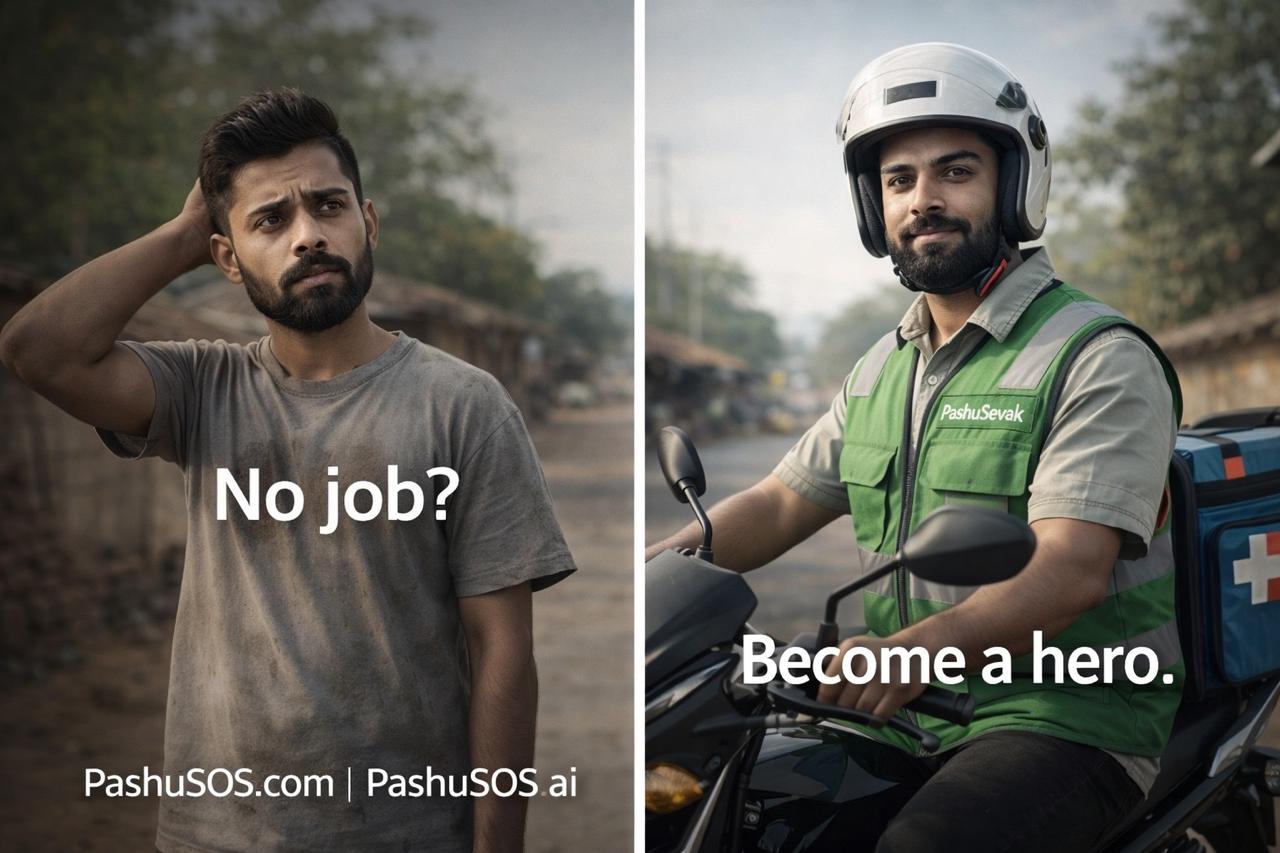
This is the layer we've spent years building at OYMOM through ZoonoTrack.AI and PashuSOS.AI. Not because it's the most fundable pitch, but because it's the actual bottleneck standing between where global food security strategy currently lives — in boardrooms — and where it will actually be decided: in villages, one animal, one farmer, one shed at a time.
— Er. Vishal Kumar Gupta, Founder & CEO, OYMOM