What I Wish Someone Had Told Me Before I Started a Veterinary Startup
29 Jul 2026 · By Er. Vishal Kumar Gupta
I get some version of the same message every month, usually from an engineer in their late twenties: "I want to build something in agri-tech or veterinary-tech. Any advice for a first-time founder in this space?"
It's a good question, and I don't think it has a clean, LinkedIn-quotable answer. But after seven years of building BPSY-VetCare, OYMOM, and now ZoonoTrack.AI, PashuSOS.AI, and NandiBaba.AI, a few things have become clear enough that I'll write them down properly, once, instead of re-explaining them in every email.
1. Learn the Regulation Before You Learn the Technology
The single most common mistake I see in early pitches is a founder who has designed an elegant AI diagnosis flow and has no idea that the Veterinary Council of India's 1984 Act governs who is legally allowed to prescribe treatment for an animal. It is not a formality you deal with after product-market fit. It is the frame your entire product has to be designed inside from day one.
Every prescription on PashuSOS.AI is approved by a licensed veterinarian — the AI triages and routes, it does not diagnose and prescribe unsupervised. This isn't a compliance checkbox we added later. It's a structural decision that shaped the entire five-tier care flow, from farmer to AI triage to field visit to doctor approval to dispensing to follow-up. If you design the elegant version first and try to retrofit compliance later, you will rebuild the product from scratch. I've watched other founders do exactly this and lose a year.
2. Your User Is Not the Farmer in Your Head
Most first-time founders in this space design for an imagined farmer who has a smartphone, reads English or at least confidently reads their regional script, has stable connectivity, and trusts new technology by default. That farmer is rare. The farmer you'll actually serve may be dealing with patchy network coverage, low formal literacy, and — this is the part people underestimate — a rational and well-earned skepticism built from years of broken promises by previous schemes and self-styled "doctors."
Design for that person from the start. OTP-based verification instead of app logins. Voice and visual cues instead of dense text. Follow-up calls at day three and day seven, not just at the point of first contact, because trust is rebuilt through consistency, not through your onboarding screen.
3. Prove It in One Block Before You Dream About the State
I started OMHPL with one lakh rupees in one block. Not because I lacked ambition, but because rural unit economics — cost per farmer acquired, cost per veterinary visit, actual repeat usage rates — do not reveal themselves in a pitch deck. They reveal themselves when you've physically walked the villages, met the farmers, and watched what breaks at fifty users that didn't break at five.
If your model doesn't work profitably in one block, it will not magically work at state scale — it will just fail more expensively and take longer to admit it. Every venture I've built started smaller than felt comfortable, and every one of them is stronger for it.
4. Distribution and Trust Are the Moat — Not the App
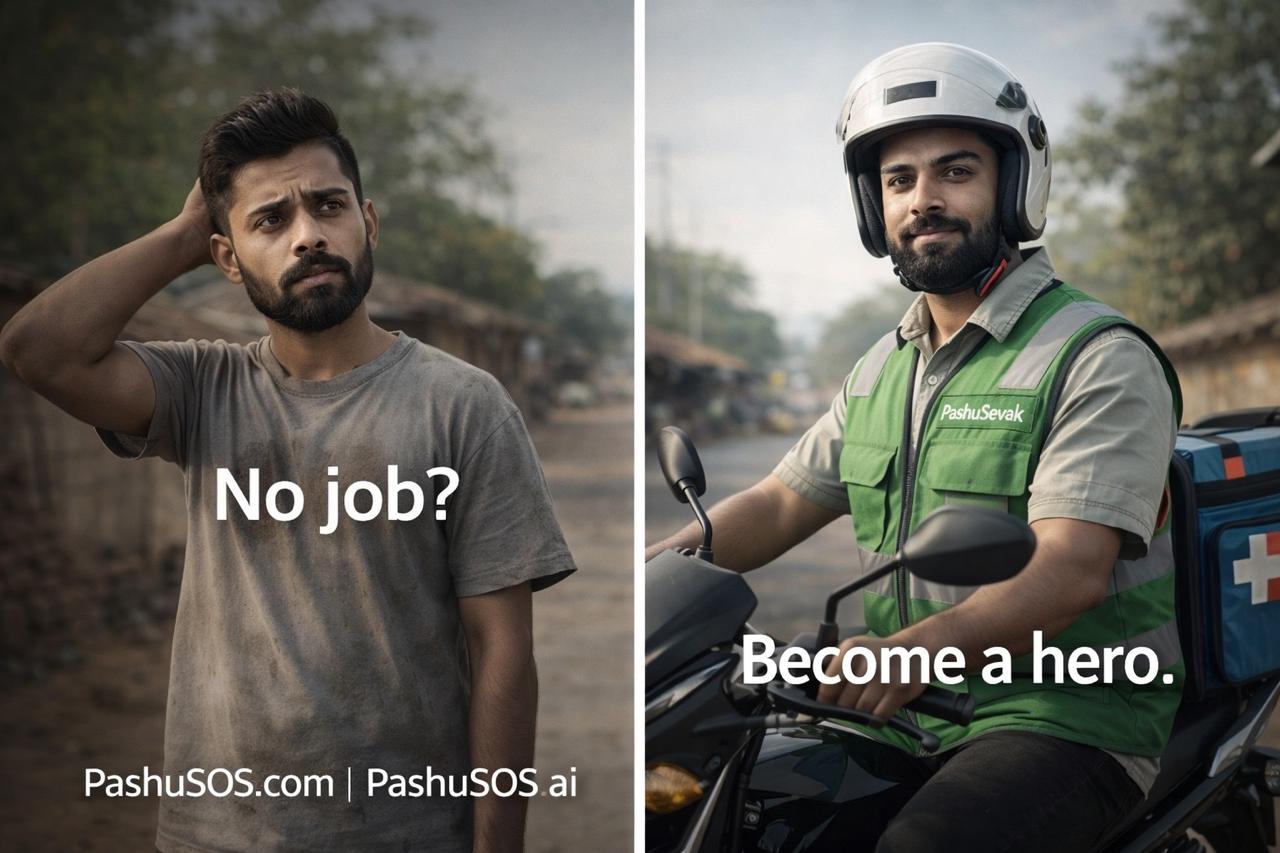
I'd estimate that founders in this sector spend roughly ten times more effort on their technology stack than on their last-mile distribution and trust network, when the ratio should probably be reversed. Any well-funded competitor can copy your app in a few months. Almost none of them can quickly replicate a farmer's trust in the PashuSevak who showed up at his shed last monsoon and actually helped, or a village's confidence that follow-up calls will genuinely happen.
If your business plan doesn't have a serious, funded answer for "who is the human being the farmer trusts, and how do we build and retain that layer," your technology plan is incomplete, no matter how good the AI is.
5. Own Your Data, or You're Building Someone Else's Product
A lot of "AI for agriculture" pitches today are, structurally, a general-purpose language model with a regional-language wrapper and a few prompt templates. That can be a legitimate starting point, but be honest with yourself and your investors about what it is. It is not the same as a model trained on proprietary, domain-specific data that actually understands your farmers' language, breed patterns, and disease presentation — because that data was never part of any general model's training set to begin with.
We're building NandiBaba.AI specifically because we concluded that the wrapper approach has a ceiling, and that ceiling matters more the deeper you go into a specific region's agricultural reality. If your long-term moat depends on model intelligence, start collecting your own proprietary training data on day one, even before you know exactly how you'll use it. By the time you need it, it will already be too late to start.
6. Hire for the Field, Not Just for the Codebase
The engineers matter. So does the person willing to visit a farmer's shed in July's monsoon mud to do a follow-up that no algorithm can do remotely yet. Early-stage founders in this sector often over-invest in engineering talent and under-invest in field operations talent, because field roles are harder to make sound impressive in a hiring pitch. In practice, your field team is doing more to determine whether this business survives its first eighteen months than your tech team is.
7. Expect Patience to Be Repaid Slowly, Then All at Once
Rural adoption compounds differently than urban digital adoption. It's slower to start, because trust has to be earned village by village rather than acquired through a performance-marketing campaign. But once a genuine trust network exists in a region, referral-driven growth in agricultural communities can be remarkably durable and remarkably cheap, because farmers talk to each other constantly and take those conversations seriously.
If your investors are expecting hockey-stick growth in month six, this may be the wrong sector for their capital, or the wrong capital for this sector. Both are fine conclusions to reach — better to reach them before you've raised the round than after.
The Honest Summary
None of this is discouraging, at least it isn't meant to be. India's veterinary and rural animal-health sector remains genuinely underbuilt, and there is real room for founders who take the unglamorous parts as seriously as the exciting ones. But this sector rewards operational discipline and regulatory literacy at least as much as it rewards technical ambition — arguably more. If you're building here because it's an interesting AI problem, that's necessary but not sufficient. Build it because you're willing to do the parts that don't make it onto the pitch deck slide.
— Er. Vishal Kumar Gupta, Founder & CEO, OYMOM